
Halperin Park
Reconnecting a Community Divided by Highway Construction
Dallas, Texas, USA
The Challenge
As one of the first Freedmen’s towns established after the Civil War, Dallas’ Oak Cliff neighborhood is central to the history of the city and African American culture. At its peak, Oak Cliff was home to a thriving regional retail corridor second only to Downtown Dallas. In the 1950’s, construction of interstate highway 35E (I-35E) cut directly through the neighborhood, demolishing homes and businesses and severing long-standing social and economic ties. Over subsequent decades, disinvestment and environmental burdens compounded these harms.
In 2017, as the Texas Department of Transportation initiated a full reconstruction of I-35E, community leaders realized an opportunity to reverse that legacy by building a park over the highway, creating new public land where none existed and reuniting the Oak Cliff neighborhood.
The Design Solution
Halperin Park is built on a structural deck over I-35E. Designed by HKS and SWA, the park is organized into a sequence of public spaces inspired by Oak Cliff’s cultural history and underlying geology.
Anchored by the 12th Street Promenade, a tree-lined pedestrian walkway with seating and cultural elements, Halperin Park features a great lawn for events that is shaded by a bandshell made of engineered wood, a material that reduces the park’s structural loads and carbon footprint. A multipurpose pavilion serves as a hub for markets, performances and gatherings, while terraced steps double as an outdoor classroom and performance space and a woodland-inspired playground offers inclusive play opportunities. Sculpted landforms built with glass fiber reinforced concrete evoke the region’s topography while buffering sound from the highway. Gardens and interactive water features foster community engagement and environmental sensitivity.
Social and environmental equity have guided the design of Halperin Park from its inception. More than 500 residents, local businesses and nonprofit organizations contributed to the park’s Community First Plan to create an inclusive space that is functional, welcoming, responsive, innovative and reflective of the neighborhoods surrounding the park.
The Design Impact
Halperin Park reconnects Oak Cliff and establishes a new civic landscape adjacent to the Dallas Zoo. Designed as both a neighborhood commons and a regional destination, the project advances the national conversation about how cities can rethink urban freeways – addressing environmental justice, mobility, access to open space and public health.
Halperin Park is being delivered in two phases. Phase I is fully funded and open; Phase 2 will extend the park to a total of five acres. Together, the park and associated projects represent the largest capital investment of its kind in Dallas. A preliminary analysis by the University of North Texas at Dallas estimates that Phase I alone could attract more than two million visitors annually and generate more than $1 billion in economic impact within its first five years, including increased property tax revenue and retail activity.


Project Features
- Promenade
- Oak Cliff Walk of Fame
- Great Lawn
- Performance Shell
- Water Features
- Multipurpose Pavilion and Plaza
- Terraced Steps
- Playground
- Gardens
- Sculpted Topography


-

Story Dallas' Halperin Park Will Bridge Generations of Divide and Inequity -

People Russell Crader
Global Practice Director, Arts & Culture
Principal
AIA, NCARB
New York
-
Office Dallas -

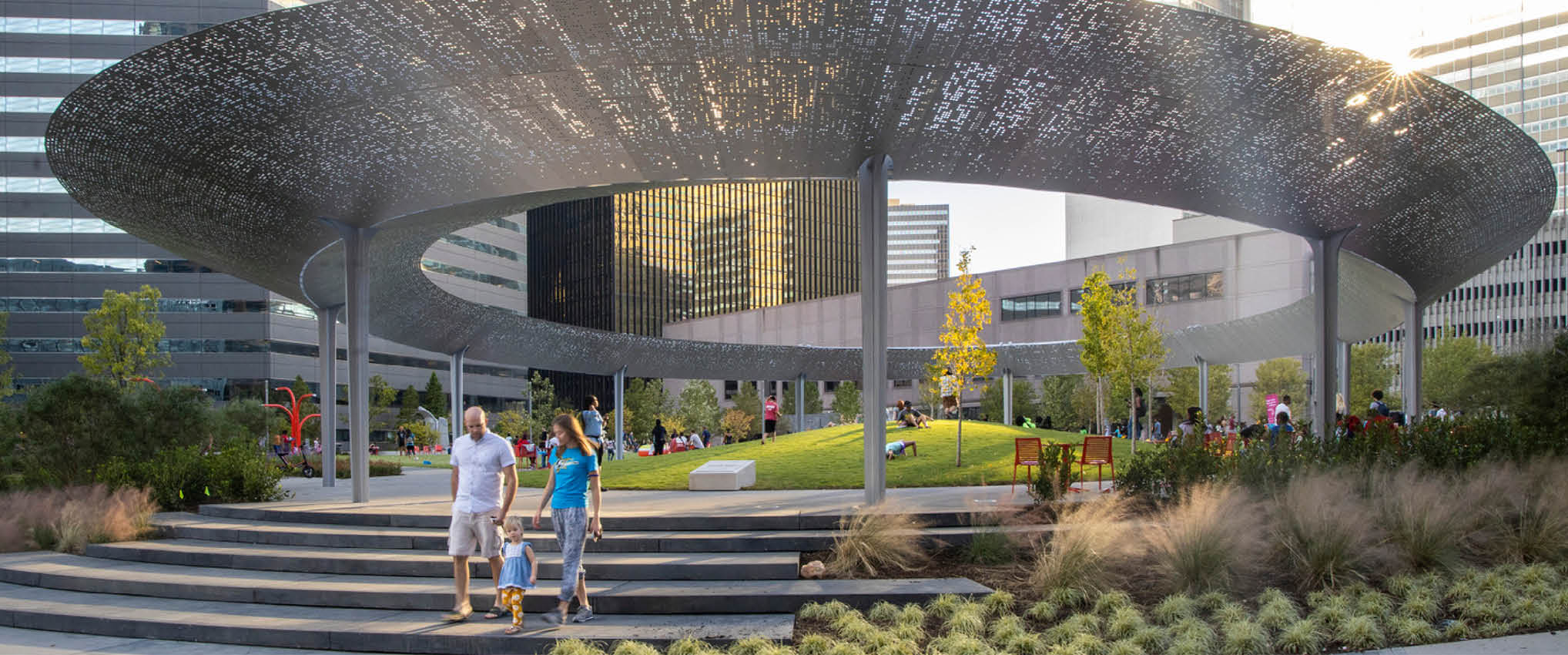
Project Pacific Plaza Pavilion -
Practice Culture -

Practice Sports & Entertainment -

Service Planning & Urban Design -

Service Structural Engineering -

People Dan Getz
Global Practice Director, Structures
Partner
PE
Dallas